Press event


Those of us who care about the Upper Miss are invited to show our support for our agencies and organizations that protect the river.
 
Please try to attend.  Thanks


Sustain our River will host a Press Conference on August 4, 2025 at the Black River Beach House at 1145 AM. Our goal is to draw awareness and facilitate discussion on the value of the Mississippi River and the federal and state agencies whose work supports the sustainability of this natural resource.

We are part of the vast web of businesses, residents, and field experts who value: the health of the Mississippi River and Great Lakes; the economic impact of recreational and commercial fisheries; and the Mississippi River navigation channel administered by the US Army Corps of Engineers.

We recognize the critical importance of dedicating funding to control: invasive species, sediment and erosion, and improve water quality, nutrient reduction and habitat restoration.

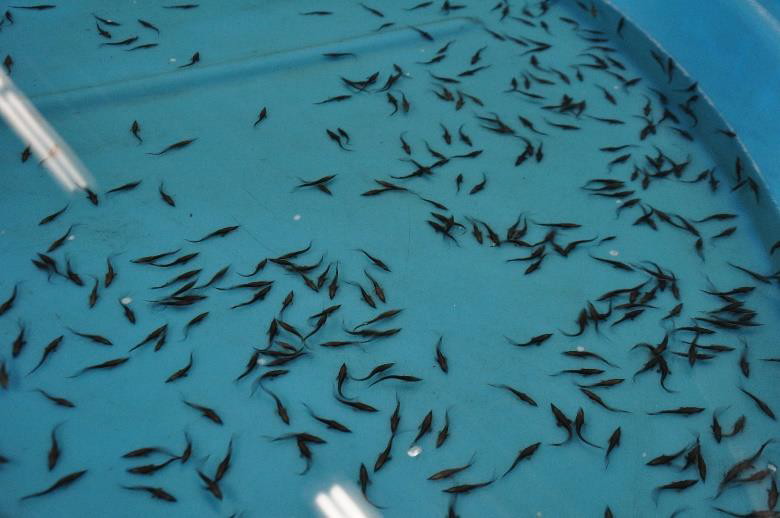
The Sea Lamprey pharmaceutical (lampricide) was developed by researchers at USGS (UMESC) Upper Midwest Environmental Sciences Center on French Island in Wisconsin.

The program is administered through the Great Lakes Fishery Commission and control activities are executed by the US Fish and Wildlife Service and Fisheries and Oceans Canada.

Controlling sea lamprey populations led to extensive recovery of the Great Lakes commercial fishery. The program boasts an exceptional return on investment and protects an annual fishery valued at nearly $7 billion including 75,000 jobs.

USGS continues protecting waterways by developing and implementing controls for invasive carp, recently found near the mouth of the Root River flowing into the Mississippi River migrating upwards to French Island.

These carp (up to 20 pounds) respond to water agitation by jumping out of the water as high as ten feet. Without dedicated controls the physical impact to boaters, skiers, even kids tubing behind boats will be devastating. The invasive carp are voracious eaters and quickly out-compete (and outgrow) native fish compromising the millions of dollars generated by recreational fishing and fishing tournaments in the Mississippi River.

Funding is imperative to uphold the Upper Mississippi River Restoration Program including the Habitat Rehabilitation and Enhancement Program (HREP) and Long-Term Resource Monitoring Program (LTRMP) both imperative to maintaining river health which supports our economic stability.

Imminent threats to our waterways are real. Investing in the Mighty Mississippi, Great Lakes and other waterways throughout our region and nationwide, is crucial to Sustain our River for the next hundred years.


Thank You


On behalf of the U.S. Fish and Wildlife Service, City of La Crosse Parks, Recreation, & Forestry, and the Friends of the Upper Mississippi, we extend our heartfelt gratitude for your participation in this year’s Youth Outdoor Fest. Your dedication and willingness to volunteer your time on a Saturday made this event a resounding success, with 1,500 participants enjoying the festivities. We truly could not have achieved this without your support and enthusiasm.

Thank you once again for your invaluable contribution.

Warm regards,

Cristina Dahl

Outreach Specialist

Midwest Fisheries Center

Photos by Dan Mckenzie and Michelle Cox


 THANK YOU! THANK YOU!

 
We had an amazing turn out at our Kids Fishing Day!  Over 350 people and over 50 staff and volunteers. I couldn’t do it without YOUR time and support!!!
 
Thank you for your patience and willingness to the new set up. I think the families really enjoyed the stations and were going back to explore them again. 
 
Thank you so much for your support towards Genoa National Fish Hatchery!!!
We appreciate you all so much ? 
 
 
Erica Rasmussen 
 
Environmental Education Specialist
Genoa National Fish Hatchery
S5631 State Hwy 35
Genoa WI, 54632
608-689-2605 

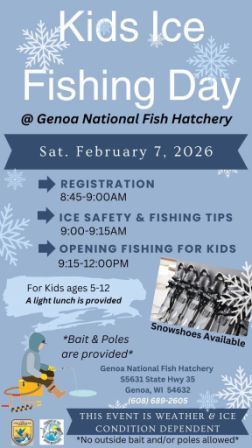
Kids Ice Fishing Day: A Fantastic Success!


The annual Kids Ice Fishing Day at Genoa National Fish Hatchery on February 1, 2025 was an incredible success, bringing together over 500 attendees, including enthusiastic staff and dedicated volunteers! Hosted by the U.S. Fish and Wildlife Service’s three La Crosse area fisheries offices, in partnership with our Friends Group, the Friends of the Upper Mississippi, this year’s event was truly a celebration of community and nature.

With 250 children aged 5-12 participating, many of whom experienced ice fishing for the first time, the day was filled with excitement and learning. Under the expert guidance of Kyle Von Ruden, a Geneticist and avid fisherman from the Midwest Fisheries Center in La Crosse, participants received valuable ice fishing tips and a vital safety briefing before heading out to fish on pond 11.

After a morning of fishing, where many young anglers caught their limit of three rainbow trout each, families enjoyed a light lunch catered by our Friends Group. A cozy warming tent with coffee and cocoa provided a perfect spot to warm up throughout the day.

A heartfelt thank you goes out to our volunteers, the Friends of the Upper Mississippi, the USFWS staff and the Roch Kendrick memorial for making this event possible. It was a wonderful morning spent outside, fostering a love for nature among children and their families! By: Erica Rasmussen


Kids Ice Fishing Day: A Fantastic Success!

The annual Kids Ice Fishing Day at Genoa National Fish Hatchery on February 1, 2025 was an incredible success, bringing together over 500 attendees, including enthusiastic staff and dedicated volunteers! Hosted by the U.S. Fish and Wildlife Service’s three La Crosse area fisheries offices, in partnership with our Friends Group, the Friends of the Upper Mississippi, this year’s event was truly a celebration of community and nature.

With 250 children aged 5-12 participating, many of whom experienced ice fishing for the first time, the day was filled with excitement and learning. Under the expert guidance of Kyle Von Ruden, a Geneticist and avid fisherman from the Midwest Fisheries Center in La Crosse, participants received valuable ice fishing tips and a vital safety briefing before heading out to fish on pond 11.

After a morning of fishing, where many young anglers caught their limit of three rainbow trout each, families enjoyed a light lunch catered by our Friends Group. A cozy warming tent with coffee and cocoa provided a perfect spot to warm up throughout the day.

A heartfelt thank you goes out to our volunteers, the Friends of the Upper Mississippi, the USFWS staff and the Roch Kendrick memorial for making this event possible. It was a wonderful morning spent outside, fostering a love for nature among children and their families!

By: Erica Rasmussen                                                Pictures below


Photos: USFWS staff, volunteers and families on a frozen hatchery pond helping youth anglers catch a fish, kids holding up fish that they just caught and kids ice fishing at Genoa National Fish Hatchery. Photo credit: USFWS.


 Coaster Brook Trout Collections at Isle Royale National Park


The U.S. Fish and Wildlife Service (USFWS) annually stocks more than a million brook trout of different life stages across the country. In the Midwest region, Iron River National Fish Hatchery maintains a captive line of Isle Royale strain coaster brook trout for stocking in Lake Superior waters in support of the Brook Trout Rehabilitation Plan for Lake Superior., Coaster brook trout exhibit a unique life history trait in their use of shoreline waters of Lake Superior. Historically, coasters were widespread throughout shoreline waters of Lake Superior. To maintain genetic diversity within the brood stock, new brood lines are periodically developed. Every three to five years biologists from the USFWS Ashland Fish and Wildlife Conservation Office, Iron River National Fish Hatchery, and Genoa National Fish Hatchery travel to Isle Royale National Park to collect gametes from the self-sustaining coaster brook trout population in Tobin Harbor.


A USFWS staff holding up a breeding male coaster Brook Trout. Photo credit: USFWS.

Isle Royale National Park is situated in northwest Lake Superior closer to Minnesota and Ontario than to mainland Michigan. The crew used the U. S. Geological Survey vessel, R/V Mayfly, to make the 60-mile trek from Grand Portage, Minnesota to a Park Service cabin in Rock Harbor and set up gear in Tobin Harbor. Tourist season was over, so power and plumbing had been shut down to the cabin. We would be on our own in the wilderness with a Honda generator, camp stove and some portable Buddy heaters to provide some comfort, communication and cooking source. Our drinking water would be from the lake itself, after a good boiling of course.
Brook trout spawning occurs in October at Isle Royale National Park. In Tobin Harbor, fish spawn along the shoreline in a mixture of sand, gravel, and cobble substrate. Fish are collected throughout Tobin Harbor using fyke nets placed along the shoreline. Nets are monitored daily, and length, weight, sex and reproductive condition data are collected from all brook trout captured. If the fish are releasing gametes, they are transferred to a temporary holding pen for spawning.
Spawning commences once we collect enough ripe adults to meet our target number of families or when we reach the deadline for the work boat to be loaded onto the Park Service vessel, Ranger III, for transport off the island. Approximately 400 eggs are collected from each female, roughly one quarter of the total produced. After milt and egg collection the fish are released back to the wild. Eggs collected from each female are evenly divided into up to five batches and each batch is fertilized with milt from one male creating up to five families per female.
The fertilized eggs are then transported from Isle Royale National Park to an isolation rearing facility at USFWS Iron River Fish Hatchery. There they are incubated, and the newly hatched fish raised to breeding age during which time they undergo several fish health inspections by staff at the USFWS La Crosse Fish Health Laboratory in Onalaska, Wisconsin. If the brood class passes three fish health inspections and are confirmed healthy, they are ready to be incorporated into the coaster brook trout brood program to produce offspring for restoration stocking by USFWS and partner fishery agencies in Lake Superior.
By: Nick Bloomfield, Henry Quinlan, Joe Amundson, and Josh Hartin